SharePoint vs OneDrive vs Teams: Where Should Your Business Files Live?
Quick answer: OneDrive is for your own work in progress, SharePoint is where files the business owns should live, and Teams is a window onto…


Quick answer: Agentic AI risks come from giving software the freedom to act on its own, not just answer questions. An AI agent that can send emails, move money, or change records can cause real harm at machine speed, and under UK law your business is liable for what it does. The fix is not banning agents. It is treating every agent like a new employee: least access, close supervision, and a clear audit trail.
A new kind of software is arriving in Aberdeen businesses, and it does not wait to be asked. AI agents do not just draft a reply or summarise a document. They act. They book the meeting, raise the invoice, update the CRM, and move on to the next task without checking in. Analysts at Gartner expect around 15% of day-to-day work decisions to be made autonomously by AI agents by 2028, up from effectively zero at the end of 2024.
That shift is genuinely useful. It is also where a lot of businesses are about to get caught out. The question is no longer “what did the AI say?” It is “what did the AI do, and who is responsible for it?”
This post breaks down the real agentic AI risks for a growing business, why they are different from the chatbot risks you already know, and the practical controls that keep an agent helpful instead of hazardous.
Most AI you have used so far is advisory. You ask a question, it produces an answer, and a person decides what to do next. A tool like Microsoft 365 Copilot Chat drafts an email, but you read it and hit send. The human is the safety check, which is the same principle behind using AI and Copilot safely at work.
Agentic AI removes that gap. An agent is given a goal, and it plans and carries out the steps to reach it on its own. It can call other software, trigger actions in your systems, and chain several decisions together in seconds.
Here is why that matters for risk. When AI only produces outputs, a mistake is an analytical problem you can catch before it does damage. When AI takes actions, every mistake carries an operational consequence straight away. The agent does not hand you a wrong answer to check. It acts on the wrong answer, and it may not be able to undo what it did.
That is the core of agentic AI risks for business. You are not managing a smarter chatbot. You are managing a digital worker with the ability to do things.
The consultancy reports on this topic run to dozens of pages, but for an Aberdeen SME the real exposure falls into four buckets.
An agent with a flawed instruction or a bad assumption can act on it repeatedly and fast. One wrong rule about which supplier to pay, or which record to overwrite, becomes a hundred wrong actions before anyone notices. Errors also propagate. A hallucinated figure early in a task can flow through several connected systems and settle in as fact.
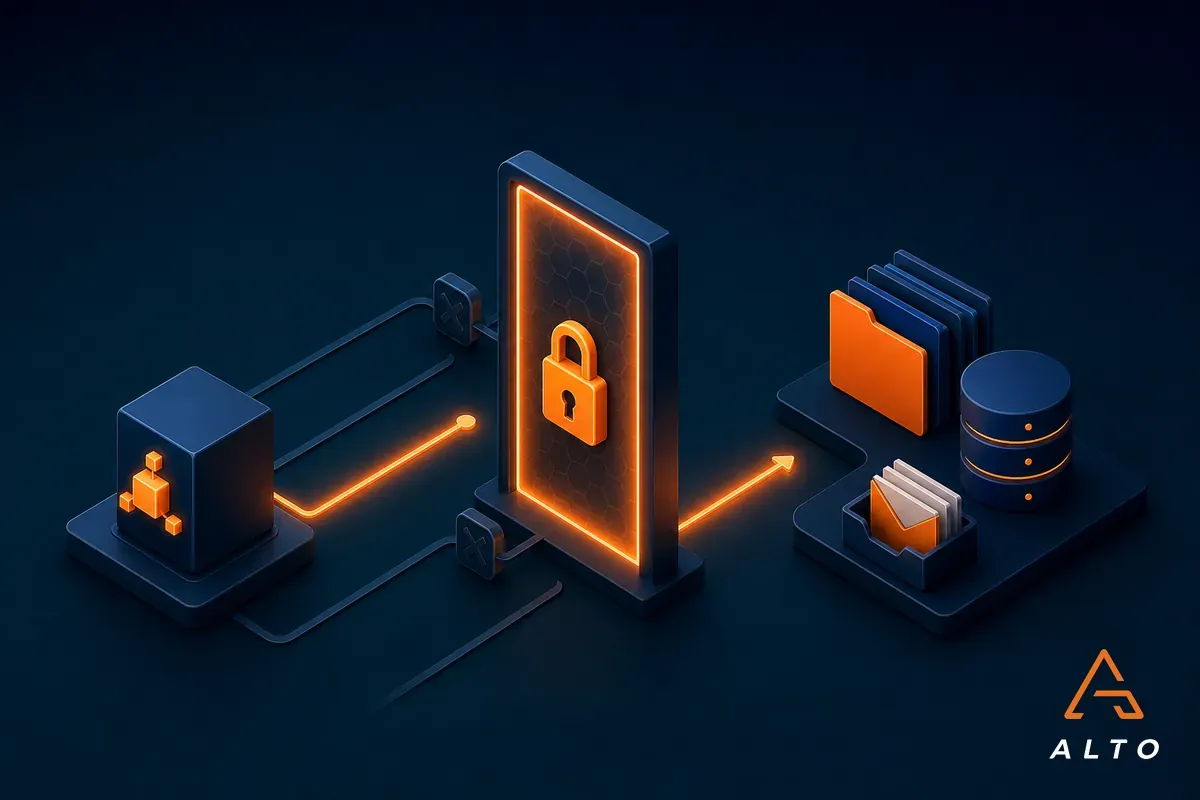
An AI agent is a new door into your systems. It has credentials, it has access, and it can be manipulated. Attackers can plant hidden instructions in a document or web page that the agent then reads and obeys, a technique called prompt injection. In security terms, an over-permissioned agent behaves like a trusted insider who can be talked into anything.
Here is the one most businesses miss. Under existing UK law, if your agent causes harm, that harm is attributed to the business that deployed it, not to the software vendor. If an agent processes personal data, mishandles a customer request, or makes a decision it should not have, the liability lands on you. The ICO has already flagged agentic AI as a data protection concern, and UK data protection duties apply just as they would to a member of staff.
An agent that emails the wrong customer, quotes the wrong price, or makes an offer you never authorised can damage trust in minutes. Autonomy means these mistakes happen without a human pause, so the first you hear of it may be the complaint.
It is tempting to file agentic AI under “things to worry about later”. That is a mistake, and here is the uncomfortable part: agents are probably already creeping into your business through the back door.
The same pattern that gave us shadow AI is repeating. Staff sign up for an agent-enabled tool to save themselves time, connect it to their email or files, and grant it access without anyone in the business knowing. Aberdeen’s core sectors, energy, engineering, and professional services, run on sensitive commercial data and tight client confidentiality. An unsanctioned agent with write-access to a shared mailbox or a project system is not a productivity win. It is an incident waiting to happen.
The businesses that handle this well are not the ones with the biggest budgets. They are the ones that decided what agents are allowed to do before an agent did something they did not expect.
Take one thing from this post: an AI agent is not a feature. It is a new worker joining your team, and it should go through the same controls you would apply to any new hire on day one.
You would not give a new starter the keys to every system, the company card, and no supervisor on their first morning. You would give them the access they need for their role, nothing more. You would check their work. You would keep a record of what they did. Agents deserve exactly the same treatment, and most of the risk disappears when they get it.
That single shift reframes the whole problem. Agentic AI risk is not really a mysterious new technology threat. It is an access-control and supervision problem, and those are problems you already know how to solve.
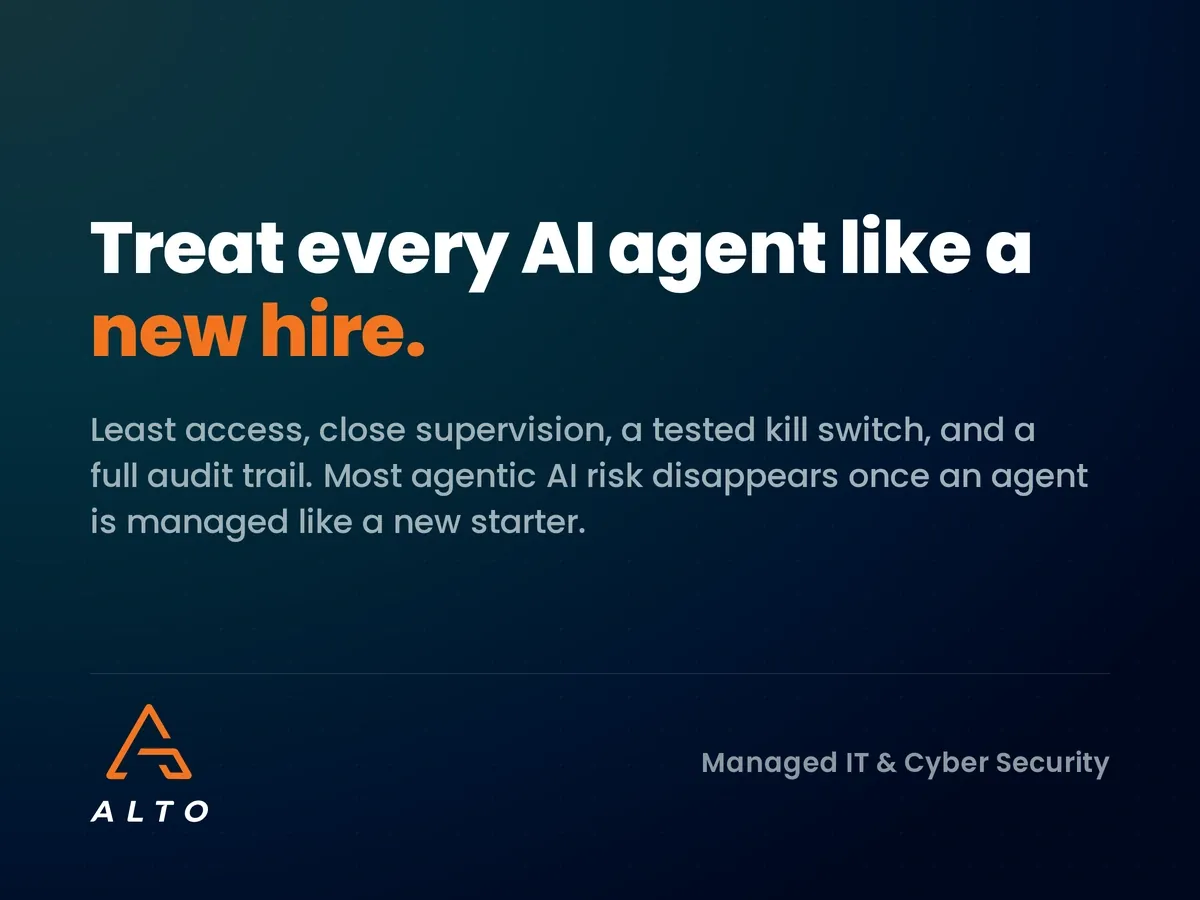
You do not need a governance department to deploy agents responsibly. You need five practical controls.
Least privilege access. Give each agent the minimum access it needs to do its job, and nothing more. An agent that books meetings does not need access to your finance system. Scope it tight.
A human in the loop for high-stakes actions. Anything involving money, contracts, personal data, or external communication should pause for human approval. Let the agent do the work; keep a person on the final click.
A tested kill switch. You need to be able to stop an agent and roll back what it did. And you need to have tested that this actually works. An untested stop button is not a control, it is a hope.
Full audit logging. Every action the agent takes should be logged so you can see what it did and when. If something goes wrong, the log is how you investigate it and prove what happened.
An AI usage policy everyone follows. A short, clear policy that says which tools are approved, what data they can touch, and who signs off on connecting an agent to a business system. This is what stops shadow agents appearing in the first place, and it works alongside the idea that you do not need to ban AI, you need a shortlist of tools you trust.
The firms that get into trouble tend to repeat the same handful of errors.
They grant broad access for convenience, because scoping permissions properly takes a few extra minutes at setup. They skip the audit log, so when something goes wrong they cannot see what the agent did. They treat the vendor’s default settings as safe, when defaults are built for ease of adoption, not for your risk appetite. And they assume the software company carries the liability, when UK law puts it squarely on the business that deployed the agent.
None of these mistakes require bad intentions. They are what happens when a powerful tool is switched on without anyone deciding the rules first.
When you are weighing up whether to let an agent handle a task, a traffic light system keeps it simple.
Green: Low-stakes, reversible tasks with no personal or sensitive data. Drafting internal notes, summarising documents, sorting a personal inbox. Let the agent run.
Amber: Tasks touching customer data, internal systems, or anything that would be awkward to undo. Allowed, but with human approval on key actions and full logging. Proceed with a person in the loop.
Red: Moving money, signing agreements, sending external communications unsupervised, or granting an agent standing access to critical systems. Stop and get a proper review before you go anywhere near this.
If you are not sure whether a task is amber or red, treat it as red until someone has thought it through.
Agentic AI is software that does not just answer questions, it takes actions to reach a goal on its own. Instead of drafting an email for you to send, an agent can send it, follow up, and update your records without being asked at each step.
The four biggest are operational risk (fast, repeated mistakes), cyber risk (a new entry point that can be manipulated), legal risk (your business is liable for what the agent does), and reputational risk (autonomous mistakes reaching customers before a human can catch them).
In most cases, yes. Under current UK law, harm caused by an AI agent is attributed to the business that deployed it, not the software vendor. If an agent mishandles personal data or makes an unauthorised decision, the liability sits with you, which is why access controls and approval steps matter.
No. Agents can save real time when they are set up properly. The answer is not to ban them but to control them: give each agent least access, keep a human in the loop for high-stakes actions, log everything, and put a short usage policy in place.
Start with a clear, simple AI usage policy that lists approved tools and explains what data they can access. Pair it with an easy route for staff to request new tools, so people are not tempted to connect an agent quietly to get their work done.
AI agents are not hype, and they are not a threat to be feared. They are a new kind of worker arriving in Aberdeen businesses whether you have a plan for them or not. The firms that benefit will be the ones that set the rules first: least access, human approval where it counts, a tested off switch, and a record of everything the agent does.
If you would rather decide those rules deliberately than discover them after an incident, that is exactly the kind of work we help Aberdeen businesses with. Alto helps growing firms adopt AI safely, from writing a practical usage policy to locking down the access an agent is given, as part of our wider cyber security support for Aberdeen businesses. Book a no-obligation AI readiness conversation with our team and we will help you work out where agents fit, and where they should stay behind a red light.
To get started, download our free AI Usage Policy template below. It gives you a plain-English starting point you can adapt for your own team, covering approved tools, data rules, and sign-off for connecting AI to your systems.
A ready-to-edit policy that sets clear rules for AI agents and other AI tools before you switch anything on. Enter your details and we will send it straight over.